




Recent global events – conflict, rising energy prices and extreme weather due to climate change – have highlighted supply chain fragility, resource scarcity and the importance of resilience. For investors, this means allocating capital to companies, assets and systems that can withstand these structural stresses and chokepoints – a change of emphasis from economic growth to security, durability and adaptation.
This shift covers five practical areas. Physical resilience protects against climate and environmental risks; resource resilience concerns the efficient use of energy, water, food and materials; societal resilience addresses healthcare, housing and demographic change; digital resilience ensures data integrity, connectivity and cybersecurity; and infrastructure resilience encompasses the systems – from logistics networks to power grids to communication towers – that keep economies functioning under stress.
Each of these dimensions are interconnected and have direct relevance for listed read estate.
Structural and cyclical drivers
The long-term investment case for resilience-oriented real estate is underpinned by three secular themes. First, growth in power demand. Grid investment jumped 17% to $483 billion in 2025 and the IEA expects it to reach over $600 billion annually by 2030[1] to meet the growing needs of data usage, AI and decarbonisation. Second, the digital transformation of economies requires major investment into wireless networks and data centres, with the latter alone forecast to need around $6.7 trillion of investment globally by the end of the decade to keep pace with computing demand, according to McKinsey[2]. Third, the reconfiguration of supply chains – driven by deglobalisation, nearshoring and the pursuit of operational resilience – is reshaping demand for logistics, transport and industrial real estate.
These themes have transformed the listed real estate landscape in recent years as REITs have led the way in resilience. New economy sectors – telecommunications, data centres and industrial – have been the fastest growing listed real estate segments alongside healthcare, rising from less than 10% of total AUM in 2010 to almost a third in 2025.

Data centres are now three times bigger than the office sector – once considered a cornerstone of the real estate market alongside retail, residential and industrial (RORI) – and are expected to grow by a further fifth in the next two years[3]. They have also been among the best-performing REIT segments over both five and ten years. As well as delivering fast-growth and attractive shareholder returns, these new economy sectors can also reduce portfolio risks. The correlation between the RORI and new economy segments is less than 50%, which means that combining them can yield significant diversification benefits.
The cyclical case is equally compelling. Listed infrastructure has historically outperformed global equities during periods of market uncertainty, delivering average excess quarterly returns of 2.5% when the VIX index has been above average. The Iran War has lifted Wall Street’s fear gauge above the 20 level that typically indicates heightened market stress and with geopolitical tensions remaining high, volatility will likely remain. Infrastructure stocks have also exhibited a positive sensitivity to surprise inflation and when interest rates decline, making them well positioned for a range of economic scenarios[4].
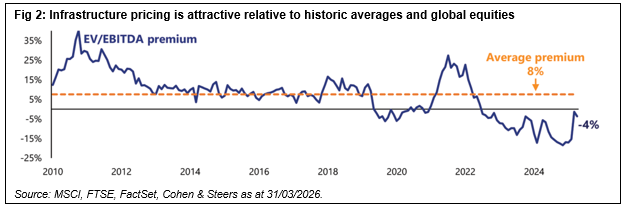
Current valuations are also attractive. Listed infrastructure trades at a rare discount of approximately 4% to global equities on an EV/EBITDA basis, compared with a long-run average premium of 8% – a dislocation that has historically preceded periods of strong relative performance.

SKAGEN m2: Where resilience meets real estate
We think of resilience as investing in infrastructure, climate adaptation, digital reliability and demographic support. Although categorised as a global listed real estate fund, SKAGEN m2’s broad and flexible mandate has enabled the portfolio to evolve with the global economy and changing market opportunity. At the end of the first quarter, around 40% of the fund was invested in infrastructure companies that span social, energy, transportation, communication and technology sectors.
Our largest holding is Equinix, the world's leading data centre operator, which was the fund’s top contributor during the first quarter and sits in the technology sector alongside Goodman Group – an Australia company that has pivoted its development pipeline toward digital infrastructure such that data centres now represent approximately two-thirds of its projects. The portfolio also includes three tower companies – Helios Towers, Cellnex Telecom and American Tower – whose assets provide the physical connectivity infrastructure that underpins digital resilience. At around 10% of NAV, these positions collectively also provide meaningful exposure to the secular growth in data consumption, cloud migration and AI-driven demand.
Within transportation we own Prologis, Catena, CTP, Americold and LOG Commercial Properties – another top performer in the first quarter. These companies, which operate across developed and emerging markets, own and develop the warehouses, cold storage facilities and distribution centres that facilitate global trade and supply chain resilience.
The portfolio has exposure to social infrastructure through US-based Brookdale Senior Living, another top Q1 contributor, compatriot CareTrust REIT and Aedifica in Belgium, all healthcare real estate companies which benefit from the demographic tailwind of ageing populations in developed markets. Our residential holdings – including Grainger in the UK, UMH Properties and Independence Realty Trust in the US – provide further societal resilience by addressing structural housing demand.
Active advantage
Despite the perception of infrastructure being a homogeneous and defensive asset class, the listed sector spans more than a dozen segments with different sensitivities to interest rates and economic activity that create a wide dispersion in returns. This favours stock pickers with research showing that active strategies outperformed passive ones by 1.3% over the ten years annualised to the end of 2025, with lower volatility and better downside protection[5]. This is mirrors listed real estate as borne out by SKAGEN m2, which has beaten its benchmark over 1,3, 5 and 10 years, as well as since inception in 2012 on an annualised basis net of fees[6].
Looking ahead, the world's most pressing challenges – digitalisation, energy security, supply chain fragility, demographic and climate change – share a common denominator: they all require infrastructure. The boundaries between infrastructure and real estate will also continue to blur. Whether it is the data centres powering AI, cell towers enabling 5G connectivity, logistics networks underpinning e-commerce or healthcare facilities serving ageing populations, these assets sit at the intersection of structural demand growth and long-term resilience.
That the sector also offers attractive valuations and defensive characteristics in an uncertain macro environment only strengthens the case. For investors with a long-term horizon, the combination of structural resilience, cyclical opportunity and a portfolio increasingly tilted towards companies that the world needs, SKAGEN m2 represents a compelling and underappreciated opportunity.
SKAGEN m2: The Data Centre Opportunity
---
All information as at 31 March 2026 unless otherwise stated.
[1] Source: Energy Investment Trends, Bloomberg NEF (2026) and Electricity Grids and Secure Energy Transitions, IEA (2023)
[2] Source: The cost of compute: A $7 trillion race to scale data centers, Mckinsey (2025)
[3] Source: Coalition Greenwich, Public Real Estate / REIT Usage Study (2024)
[4] Source: MSCI, FTSE, FactSet, Cohen & Steers (2026)
[5] Source: eVestment Alliance, Cohen & Steers (2026)
[6] SKAGEN m2 B. Inception date: 31/10/2012