
Disciplined, flexible and trend-driven
Delphi’s investment approach is built on momentum - the academic term for persistent trends in equity markets - combined with rigorous fundamental analysis and the informed judgment of our portfolio managers.
We identify companies with strong price and earnings momentum, investing in a disciplined manner in the most robust trends, and adjusting our positions as underlying conditions evolve.
The strategy is firmly grounded in academic research and has, over time, proven to be a resilient source of risk-adjusted returns. Delphi has applied this methodology since 1991.
We manage concentrated, benchmark-independent portfolios with the objective of delivering long-term, risk-adjusted outperformance for our investors.
From screening to portfolio
Systematic selection of the strongest trends
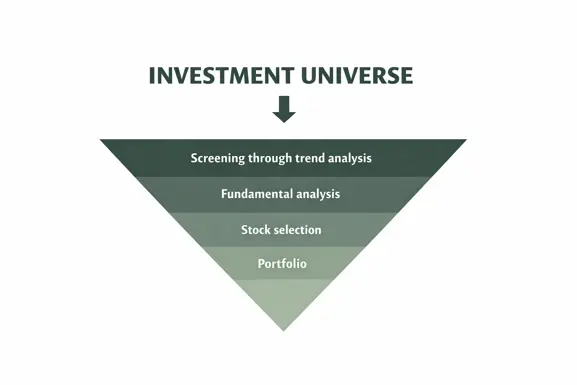
Our starting point is a broad global investment universe consisting of more than 3,000 equities.
Using our proprietary trend model - our “map and compass” - we systematically and automatically screen stocks based on factors including:
- Price performance over 3, 6, and 12 months
- Changes in analysts’ earnings estimates
This process identifies companies exhibiting both strong price momentum and improving earnings dynamics.
We then conduct thorough fundamental analysis before any stock is considered for inclusion in the portfolio. The process is disciplined and continuous, with portfolios adjusted as underlying conditions evolve.
The result is a concentrated portfolio of companies demonstrating strength in both market performance and fundamental characteristics.

Investment philosophy
Long-term movements in stock prices often reflect improvements in companies’ underlying earnings. Historical data show that companies with strong price and earnings performance often continue to perform well over time—past winners are often future winners.
Delphi’s investment philosophy is grounded in solid academic research on “momentum,” which is a systematic factor premium in the equity market. There is extensive empirical evidence that the momentum effect occurs across markets and asset classes.
Over longer time horizons, serial correlation in stock prices has repeatedly proven to be a robust source of risk-adjusted excess returns.
Investment process
From investment universe to portfolio
Illustrated by the equity fund Delphi Global
Our active investment process begins by filtering the global investment universe based on Storebrand AM’s exclusion criteria.
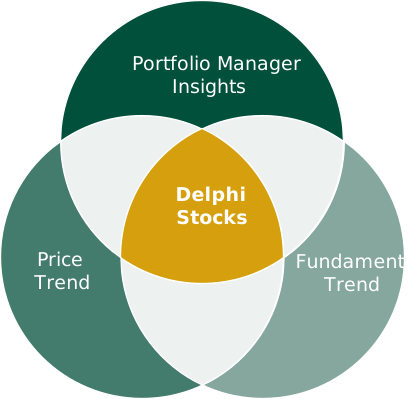
We then use a proprietary, quantitative screening process that identifies attractive investment candidates based on:
- stock price trends (price trend)
- revisions in analysts’ estimates (fundamental trend)
The subsequent qualitative, fundamental analysis assesses whether the positive price trends are likely to persist. The analysis focuses in particular on the drivers of earnings improvement and the potential for further upward revisions in analysts’ estimates.
The portfolio manager makes the final investment decisions and executes trades in accordance with the investment mandate and best execution principles. The portfolio is constructed to ensure good risk diversification and exposure to multiple value drivers.

Portfolio management team
Delphi’s portfolio management team works in close collaboration, exchanging knowledge and ideas across all investment areas.